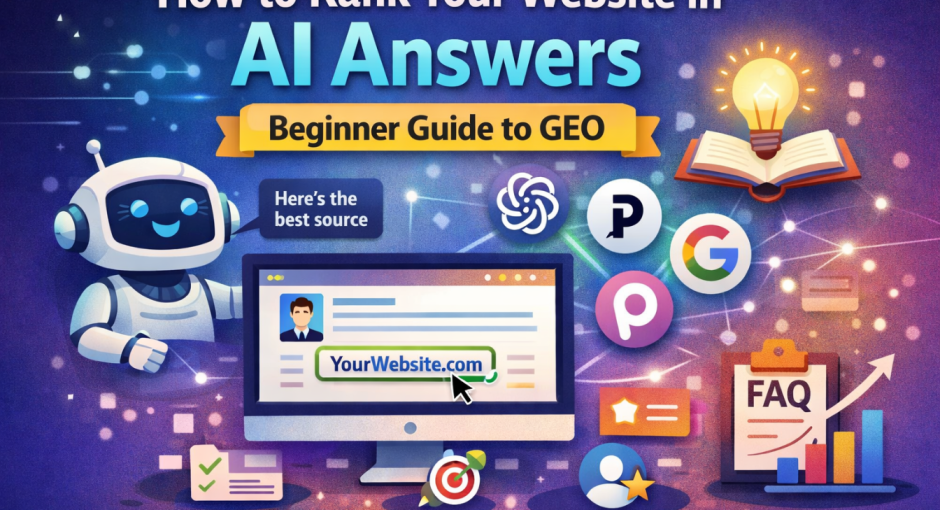

The Future of SEO is GEO: How to Rank in AI Search Engines
Search is changing very fast. Earlier, people used search engines to find websites. Today, AI tools are giving direct answers instead of only links.
Modern AI systems can read many websites and generate a summary answer for users. Because of this change, marketers, Students are now talking about a new concept called Generative Engine Optimization (GEO).
Generative Engine Optimization means optimizing your website so AI tools can use your content as a reference in their answers.
AI search tools such as Google SGE (Search Generative Experience), ChatGPT, Perplexity AI, and Microsoft Copilot are changing how people search online.
In this beginner-friendly guide, you will learn 14 practical steps to rank inside AI-generated answers.
Step 1: Understand Traditional SEO & AI Search
- Traditional SEO focuses on ranking your website on search engines like Google.
- AI tools read many websites, understand the information, and create a summary answer. Sometimes they also show source links used to generate the answer.
Step 2: Write Content in Question–Answer Format
Most users ask questions when using AI search tools. If your artical answers these questions clearly, AI systems can easily extract information from your page. This simple format increases the chance that AI tools will reference your content.
Step 3: Use Simple and Clear Language
AI systems prefer content that is easy to understand. Avoid complicated words or confusing sentences. Simple content is easier for both AI systems and beginners to understand.
Step 4: Use Clear Headings
Headings help AI tools understand the structure of your article.
Clear headings help AI quickly find the right information in your article. There must be one heding, one-sub heading & One sub-sub heading.
Step 5: Add FAQ Sections
FAQ sections are very powerful for GEO. Adding FAQs increases the chances of appearing in AI answers. AI tools often pull answers from FAQ blocks because they are easy to read and understand.
Step 6: Use Structured Data (Schema Markup)
Schema markup helps search engines and AI tools understand your content.
It adds extra information about your article such as Author, Topic, Publish date, FAQs, Business details. For example, an article schema tells search engines that your page is a blog post written by an expert. Structured data improves both SEO and GEO performance.
Step 7: Build Topical Authority
AI tools trust websites that focus deeply on one topic. If your website talks about many unrelated topics, AI may not consider it an expert source. This builds topical authority, which AI systems trust more.
Step 8: Use Structured Content Blocks
AI tools prefer well-structured content.
A good article structure may include sections like Definition, Examples, Step-by-step instructions, Advantages, Case study, Summary etc.
This structure helps AI extract information easily.
Step 9: Build Author Authority
AI tools trust real experts. Every blog post should include an author section. Adding author information builds credibility and trust.
Step 10: Get Mentions from Other Websites
AI systems also learn from information across the internet.
If your website or brand is mentioned on other platforms, AI considers it more trustworthy.
Good platforms for mentions include like LinkedIn, Medium, Quora, Reddit, Industry blogs etc.
The more trusted websites mention your brand, the stronger your authority becomes.
Step 11: Optimize Your Google Business Profile
For local searches, AI tools often use information from Google Business Profile.
For example, when someone searches: “Best digital marketing institute near me”
AI may show information based on reviews, business description, ratings, location, services etc.
Optimizing your business profile helps your brand appear in AI-powered local results.
Step 12: Create Detailed Educational Guides
AI systems prefer high-quality educational content. Long guides often perform better than short articles. So always write articles which provide detailed information that AI tools can reference easily.
Step 13: Update Your Content Regularly
Fresh content is very important. AI tools prefer updated articles because they provide more accurate information. Updating content keeps your website relevant in AI search results.
Step 14: Use Real Data and Examples
AI tools trust content supported by Graphcs & Charts, Facts & Statistics. Using data makes your content more trustworthy and more likely to be cited by AI systems.
1. What is Generative Engine Optimization (GEO)?
Generative Engine Optimization (GEO) is the process of optimizing your website so AI search engines can use your content as a reference when generating answers for users.
2. How is GEO different from traditional SEO?
Traditional SEO focuses on ranking websites in search results, while GEO focuses on making your content appear as a source inside AI-generated answers.
3. Why is GEO becoming important in digital marketing?
AI search tools are becoming more popular. Many users now ask questions directly to AI systems instead of browsing many websites.
4. Which AI tools use Generative Search?
Popular AI search tools include ChatGPT, Perplexity AI, Microsoft Copilot, and Google SGE (Search Generative Experience).
5. How do AI search engines choose their sources?
AI tools analyze multiple websites and choose sources based on content quality, authority, clarity, and relevance to the user’s question.
6. What type of content works best for GEO?
Educational content works best for GEO, such as tutorials, step-by-step guides, beginner explanations, and FAQ sections.
7. Why is structured content important for GEO?
Structured content with headings, bullet points, and short paragraphs helps AI systems understand and extract information easily.
8. Does schema markup help in Generative Engine Optimization?
Yes. Schema markup helps search engines and AI systems understand your content better by providing structured information about your article.
9. How does topical authority improve GEO ranking?
When your website publishes multiple articles about the same topic, AI systems recognize it as a trusted expert source.
10. Can WordPress websites rank in AI-generated answers?
Yes. WordPress websites can rank in AI answers if the content is well structured, helpful, and optimized for SEO and GEO.
11. Why are FAQ sections useful for GEO?
FAQ sections provide direct answers to common questions, which makes it easier for AI systems to extract and display the information.
12. How does Google Business Profile help with AI search?
A well-optimized Google Business Profile helps AI tools provide accurate local business information in AI-generated search results.
13. Does long-form content perform better in AI search?
Yes. Detailed guides usually perform better because they provide more useful information for AI systems to analyze and reference.
14. How can beginners start learning GEO?
Beginners can start by learning basic SEO, writing helpful blog posts, creating structured content, and publishing educational articles regularly.
15. What is the future of GEO in digital marketing?
GEO is expected to become an important part of digital marketing as AI-powered search engines continue to grow and change how people find information online.







22 comments On How to Rank Your Website in AI Answers: Beginner Guide to GEO
Pingback: tirzepatide vs semaglutide for cardiovascular health ()
Pingback: topiramate ()
Pingback: viagra online us ()
Pingback: doxycycline drinking alcohol reddit ()
Pingback: metronidazole gel price ()
Pingback: taking tadalafil daily ()
Pingback: orlistat and triglycerides ()
Pingback: terbinafine treatment basics ()
Pingback: toradol short term use explained ()
Pingback: ivermectin for papulopustular rosacea ()
Pingback: minoxidil time to effect ()
Pingback: minoxidil women’s frontal thinning guide ()
Pingback: sildenafil medication conflicts ()
Pingback: sildenafil fake product warning ()
Pingback: vardenafil renal contraindications ()
Pingback: orlistat use contraindications ()
Pingback: orlistat food digestion interaction ()
Pingback: augmentin therapeutic indications ()
Pingback: amoxicillin interaction details ()
Pingback: Onset Pharmacology Resource ()
Pingback: Viagra vs sildenafil PK/PD ()
Pingback: sildenafil bioavailability and half-life ()
Comments are closed.